I keep thinking about that scene in Moneyball where Billy Beane walks into a room full of old-school scouts talking about a player’s girlfriend and whether he has “the look.” Meanwhile, his analytics guy is quietly crunching numbers that reveal which players actually win games, much like the emerging strategies in executive recruitment.
That was 2002. The Oakland A’s used data to find undervalued talent and compete with teams that had triple their budget. They didn’t just change baseball strategy, they challenged the entire industry and had them question whether conventional wisdom was actually wise.
I’m seeing the exact same dynamic play out in executive search right now.
How We’ve Always Done It
For decades, executive search has operated on three pillars: who you know, what your gut tells you, and where someone went to school or worked before.
I’m not saying these factors are worthless. Your network can surface great candidates. Experienced recruiters develop real instincts for reading people. And yes, there’s usually a reason certain companies and schools have strong reputations.
But here’s the problem: networks tend to be homogeneous, instincts carry unconscious biases, and pedigree doesn’t always predict performance. We’ve been making million-dollar leadership bets based on pattern recognition that might be fundamentally flawed.
It’s like those baseball scouts who insisted a player couldn’t hit because of his batting stance, while completely ignoring his on-base percentage.
The Numbers Game
What’s different now is that we finally have the data and tools to do better. Some search firms are still skeptical, worried that analytics will somehow kill the art of executive assessment. But the most successful baseball teams today use more data than ever and they use it smarter.
Here’s what I’m seeing work in practice:
Tracking what actually predicts success. Instead of assuming that CEO experience automatically makes someone a better CEO candidate, we analyze historical placements to see which factors actually correlate with performance. Sometimes it’s industry experience. Sometimes it’s how they handled a specific type of crisis. Often it’s not what you’d expect.
Finding talent in unexpected places. AI can map talent across industries and geographies in ways human networks simply can’t match. I’ve seen searches uncover phenomenal candidates who would never have made it onto a traditional shortlist not because they weren’t qualified, but because they weren’t visible to the usual channels.
Measuring cultural chemistry before the hire. Rather than relying on interview impressions and reference calls, we are analyzing communication patterns, leadership styles, and collaboration histories to predict how well someone will integrate with an existing team.
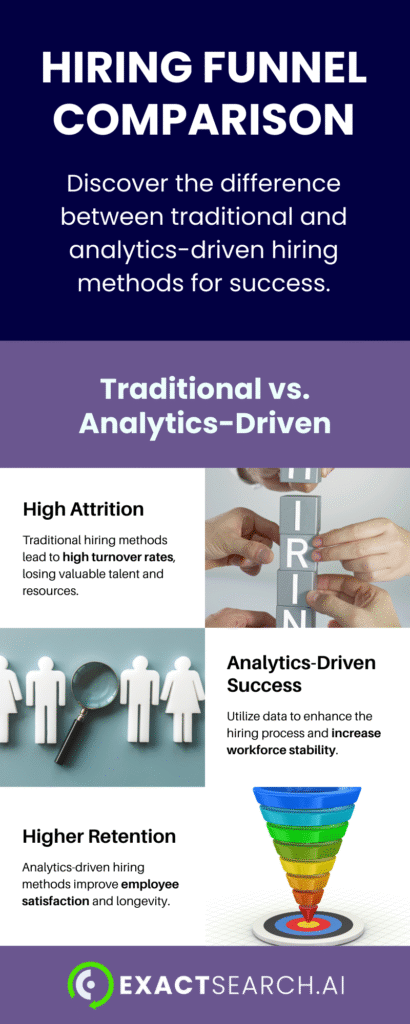
Predicting who will stick around. Retention models can factor in everything from career trajectory to market conditions to personal circumstances, giving you a much better sense of whether someone is likely to succeed and stay in the role long-term.
Why This Matters More Than Ever in Executive Search
The margin for error in leadership hiring is slimmer than ever. Between digital transformation, market volatility, regulatory changes, and shifting workforce expectations, a bad executive hire doesn’t just cost money, it can derail entire business strategies.
Making leadership hiring decisions based primarily on instinct and relationships is ripe for an intelligent upgrade. It’s just like when they were using 1980s scouting methods.
Where This Could Go
If we’re really at the beginning of an analytics revolution in executive search, what might the next phase look like?
I imagine we’ll see continuous talent intelligence, platforms that track and score potential candidates in real time, so you’re not starting from scratch every time a role opens up. Search processes might include scenario modeling that shows how a candidate might perform under different market conditions or organizational challenges.
Boards could have live dashboards showing their leadership bench strength and succession readiness. We might even develop behavioral models sophisticated enough to simulate how different leadership styles would play out in specific situations before making an offer.
The Human Element isn’t Going Anywhere
Here’s what I want to be clear about: Billy Beane didn’t fire all the scouts and let a computer manage the team. The most successful analytics approaches in baseball combine data insights with human judgment about things like leadership, resilience, and potential.
The same will be true in executive search. You still need people who can assess executive presence, understand organizational dynamics, and spot red flags. The difference is that these human insights become sharper when they’re informed by the rigorous analysis AI can offer.
The Competitive Reality
Companies that embraced data-driven hiring have a clear advantage with better insights resulting in stronger leaders.
The companies using analytics aren’t just finding better executives, they’re actually finding them faster. In a business environment where leadership decisions can determine competitive advantage, that’s not just helpful, it can be essential.

The Choice Ahead
We’re at one of those inflection points where industries split between early adopters and everyone else. The companies that figure out how to blend human insight with analytical rigor will set the standard for leadership hiring. The ones that don’t will find themselves competing with outdated methods.
The question isn’t whether data will transform executive search because it’s already happening. The question is whether your organization will be among the first to benefit from that transformation.
Twenty years after Moneyball, you can’t compete in baseball without analytics. I suspect we’ll say the same thing about executive search sooner than most people think.